The Warren Hill Tunnel stands as one of Newmarket's most remarkable yet understated landmarks. Completed in 1854, this subterranean railway passage allowed the steam age to advance through the town without disturbing the sacred training grounds that have defined Newmarket as the home of British horse racing for over three centuries.
The Racing Town Meets the Railway Age
Newmarket's identity as the capital of British horse racing was already firmly established by the mid-19th century. Royal patronage dating from James I in the 17th century, followed by Charles I and Charles II, had transformed the heath into the centre of the racing world. By the 1850s, the town hosted 70 training yards, housed 3,000 horses, and operated more than 60 stud farms across two racecourses.
When railway companies sought to extend their networks into Newmarket, they faced an unusual constraint. The Warren Hill gallops, part of the Bury Side training grounds that include Long Hill and the Limekilns, represented irreplaceable territory. These grasslands were where racehorses built their fitness; any interruption would threaten the industry's viability.
Engineering a Solution
The Newmarket and Chesterford Railway, which had opened a terminus station in the town in 1848, resolved to extend the line northeast towards Bury St Edmunds. The obstacle was Warren Hill itself, and more precisely, what lay atop it. Rather than carve a cutting through the gallops or route trains around the training grounds, the railway's engineers, Robert Stephenson and John Braithwaite, elected to go underneath.
Construction began on 16 June 1852, notably before the company had secured full legal powers for the extension. The work proceeded through the hill for nearly two years. When the tunnel opened to traffic on 15 March 1854, it measured approximately 1,100 yards (1,006 metres) in length, though some sources cite a slightly shorter figure of 1,010 yards.
The project was backed by the Jockey Club, whose representative reportedly observed that the railway would enable Members of Parliament to "superintend a race and run back to London in time for the same night's debate." This support reflected a pragmatic accommodation between the ancient sport and modern transport.
A Railway Hub Evolves
The tunnel's completion transformed Newmarket's railway operations. The original 1848 terminus had required trains to reverse in and out, an arrangement that persisted until the through line opened. In 1879, low-level platforms connected to the tunnel alignment finally resolved this bottleneck.
The racing connection endured. On 4 April 1885, the Great Eastern Railway opened Warren Hill station at the tunnel's northern portal, built specifically to serve race-day traffic from northern England. Race specials brought spectators directly to the heath until the station closed around 1948. The platforms survived into the 1980s before removal.
Enduring Infrastructure
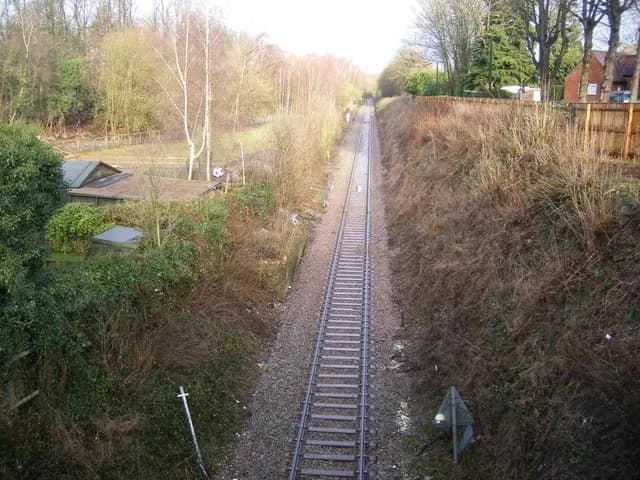
Unlike the stations that served it, the Warren Hill Tunnel remains in daily use more than 170 years after its construction. The line, now part of the Ipswich to Ely route operated by Greater Anglia, was singled in 1983. Trains still emerge from the tunnel's southern portal near the site of the demolished 1848 station, now occupied by housing, before continuing through Newmarket's current station towards Cambridge and beyond.
The tunnel represents a rare 19th-century compromise between industrial expansion and environmental preservation. Where other railway projects of the era ploughed through landscapes regardless of local opposition, the Newmarket and Chesterford Railway burrowed beneath the heath to protect the training grounds above. The gallops remain in use today, as does the tunnel beneath them; both continue to serve the town's twin purposes of racing and connectivity.