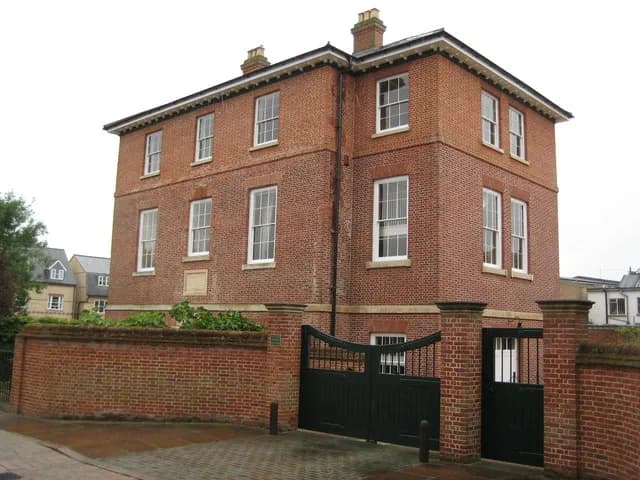
Palace House in Newmarket is the sole surviving fragment of a royal sporting palace that helped establish the town as the home of British horseracing. The building now anchors a five-acre heritage centre that draws visitors from across the country.
From Royal Residence to Rothschild Estate
The site's royal history began before Charles II. James I first visited Newmarket in 1605 and bought the Griffin inn for £400 in 1608. New lodgings designed by Simon Basil were completed in 1615 at a cost of £4,000, with stables, kennels and a Prince of Wales lodging block designed by Inigo Jones.
After the earlier palace was demolished during the Commonwealth, Charles II bought a plot on the High Street in 1668 and commissioned William Samwell to build a new residence. The resulting structure was a brick building of two storeys with attics, consisting of linked pavilions in the French style that has been described as an elegant essay in Dutch classicism. The diarist John Evelyn was less impressed, calling it "meane enough, and hardly capable for a hunting house, let alone a royal palace!" Charles II nevertheless added a training yard and Palace House stables, embedding Newmarket at the centre of English horseracing.
The property remained in Crown hands until 1819, when most of the palace was sold and demolished to make way for shops and houses. The Prince Regent, later George IV, bought the king's pavilion and stables before the sale. In 1857, Queen Victoria sold the remaining house and stables to Mayer Amschel de Rothschild. His son Leopold inherited the property in 1874 and built the Rothschild Yard and Stables in 1903, adjacent to the King's Yard Stables. During the Second World War, Palace House was used to house Jewish refugees.
Rescue and Restoration
The Rothschild family sold the Palace House estate in 1985, but by 1992 the buildings had fallen into such disrepair that Forest Heath District Council acquired the estate through a compulsory purchase order. Restoration followed with support from the National Lottery Heritage Fund and English Heritage. During the works, one of Samwell's bricked-up sash windows was uncovered; it is the oldest surviving window of its type.
The Museum Finds a Home
The National Horseracing Museum owes its existence to Major David Swannell, a Jockey Club handicapper who proposed the museum after the Jockey Club Subscription Rooms closed in 1981. The museum first opened on 30 April 1983, housed in the Jockey Club Rooms on Newmarket High Street and inaugurated by Elizabeth II.
The move to Palace House took more than two decades to realise. In 2005, Forest Heath District Council and the museum established the Home of Horseracing Trust to raise funds for a new centre at Palace Street. The National Horseracing Museum, together with the British Sporting Art Trust and Retraining of Racehorses, finally relocated to the Palace House estate in 2016. The combined National Heritage Centre for Horseracing and Sporting Art was opened by Elizabeth II on 3 November 2016.
Palace House Today
The estate now covers five acres on Palace Street. The Trainer's House and King's Yard Stables house the museum's collections, including jockey silks worn by Lester Piggott and Frankie Dettori and a racehorse simulator. Palace House itself contains the Fred Packard Museum and Galleries of British Sporting Art, featuring works by George Stubbs, Sir Alfred Munnings and Lucy Kemp-Welch, and serves as the offices of the British Sporting Art Trust. The Rothschild Yard is home to Retraining of Racehorses, where visitors can meet retired racehorses.
The centre has collected several accolades since opening. It was a finalist for the Art Fund Museum of the Year in 2017, won the small visitor attraction of the year at the East Anglian Daily Times Norfolk and Suffolk Tourism Awards in 2020, and was highly commended runner-up in the large museum category at the Suffolk Museum of the Year Awards in 2022. In May 2024, Queen Camilla succeeded Elizabeth II as the museum's patron, continuing a royal connection that spans more than four centuries.